
How to draw cyclic peptides and disulfide bridges
Type the peptide in HELM with a connection, such as PEPTIDE1{C.Y.I.Q.N.C.P.L.G}$PEPTIDE1,PEPTIDE1,1:R3-6:R3$$ for oxytocin's disulfide, into Quick insert and choose Build from HELM. The builder names the link (Cys1-Cys6) before you press Insert.
Steps
Press / for Quick insert.
Type or paste the peptide in HELM, with the link after the first
$. For oxytocin's disulfide:PEPTIDE1{C.Y.I.Q.N.C.P.L.G}$PEPTIDE1,PEPTIDE1,1:R3-6:R3$$Choose Build from HELM. The builder reads it back, with the link in brackets: "H-Cys-Tyr-Ile-Gln-Asn-Cys-Pro-Leu-Gly-OH (Cys1-Cys6)".
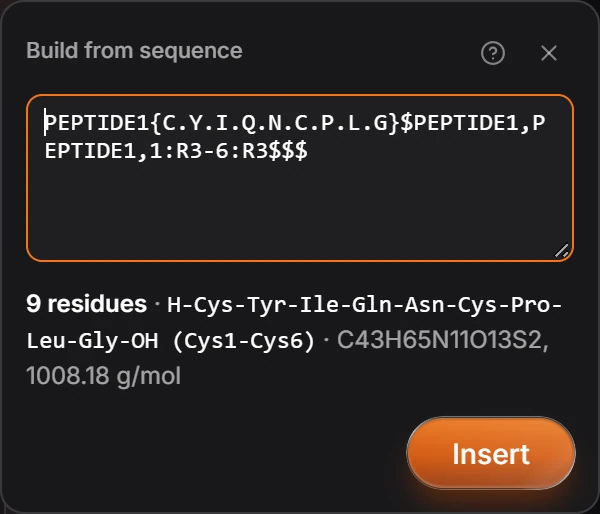
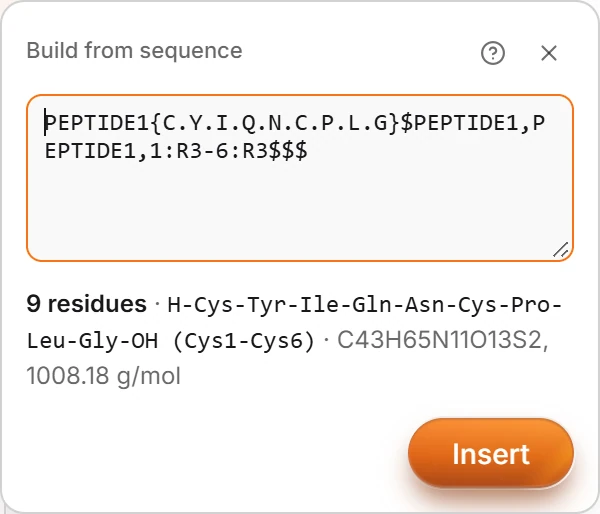
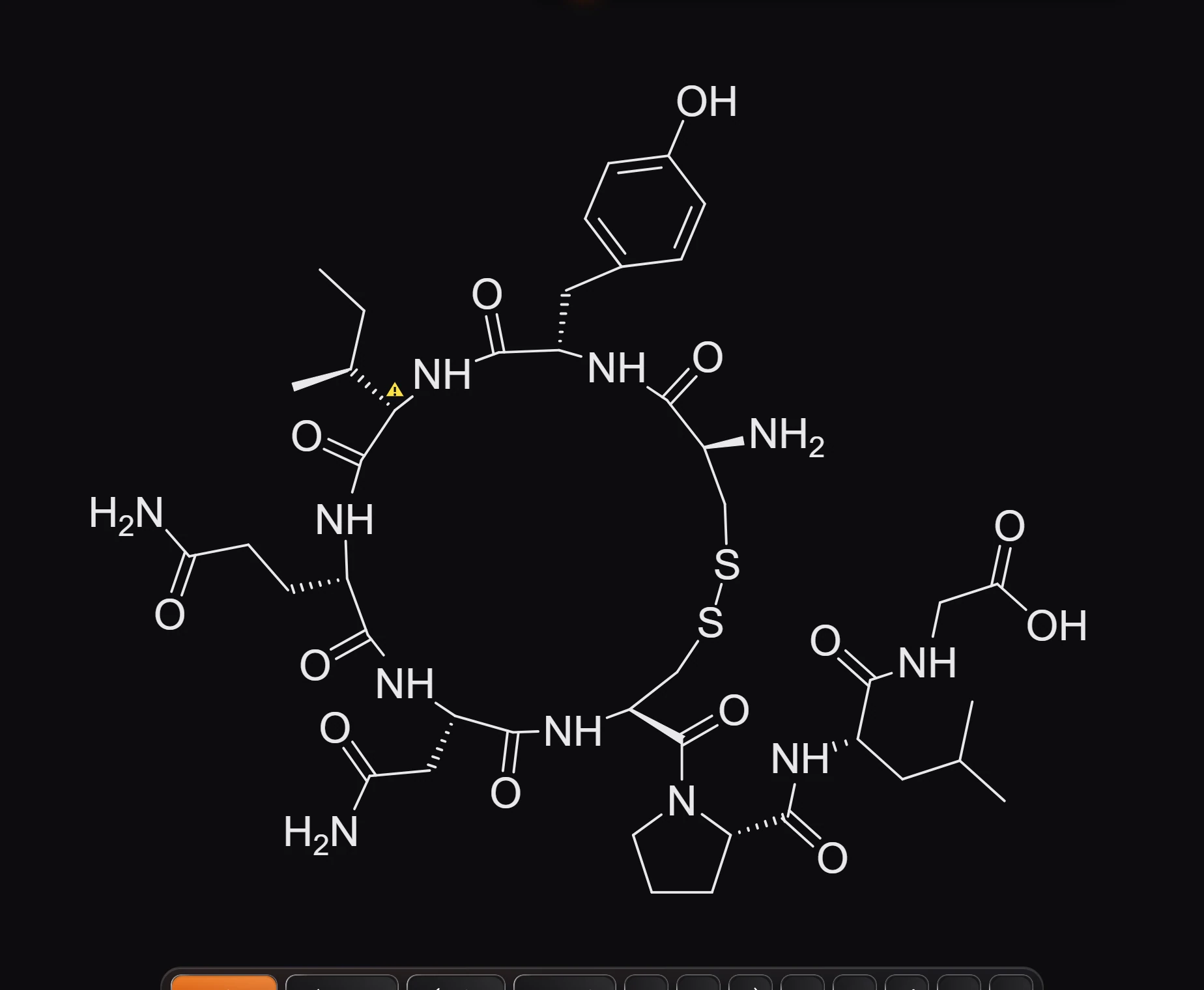
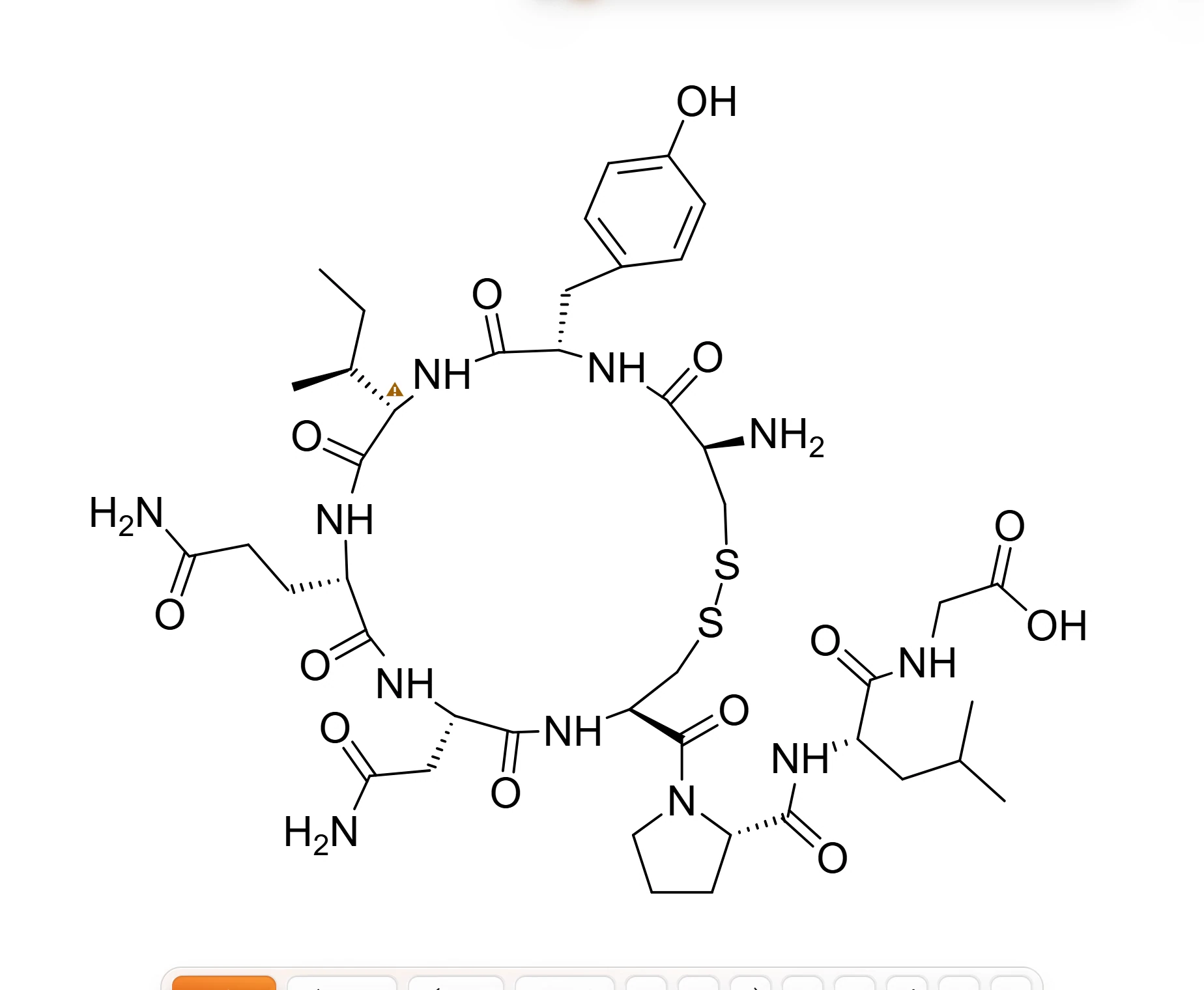
Press Insert. The peptide is drawn with the ring closed through the S-S bond.
Writing the link
A HELM connection names two residues and the attachment point on each: PEPTIDE1,PEPTIDE1,1:R3-6:R3 joins residue 1 to residue 6.
| Link | Write | Joins |
|---|---|---|
| Disulfide | 1:R3-6:R3 |
The side-chain sulfur of two cysteines (R3 is the side chain) |
| Head to tail | 5:R2-1:R1 |
The last residue's carboxyl (R2) to the first residue's amine (R1) |
A head-to-tail ring is named as a cyclic peptide: PEPTIDE1{G.G.A.G.G}$PEPTIDE1,PEPTIDE1,5:R2-1:R1$$ reads back as "cyclo(-Gly-Gly-Ala-Gly-Gly-)".
The residue codes are the monomers Athanor knows. For HELM itself, see HELM.
Is this helpful?
Last updated Nov 15, 2026
- Still stuck? Read the FAQ or contact support.
- Something wrong on this page? Tell us.
- For AI tools: llms.txt